
YUSUF MUHAMMAD MUSA
❯ AI SYSTEMS ENGINEER
End to end, from model to decision.
I build on software engineering fundamentals most ML engineers skip. Clean architecture, reliable systems, code that holds under production load — that's the floor everything else sits on.
The data infrastructure layer came next. High-volume pipelines, complex APIs, distributed storage. The part most ML projects quietly fail at before a model ever trains.
Now I build where all of it converges — solvers, models, and deployment pipelines as a single system. End to end. From raw data to a decision that runs in the real world.
DECISION INTELLIGENCE IN ACTION
A live window into how constraints collapse into a single optimal decision — the core of what the three layers below produce.
AGENTIC WORKFLOWS & REAL-TIME INFERENCE ENGINE
Integrating AI models into production systems as decision-making engines embedded in real workflows, not demos.
MATHEMATICAL SOLVER & PRESCRIPTIVE ANALYTICS
Building mathematical models that prescribe the best action, not just predict, utilizing operations research.
FULL-STACK INFRASTRUCTURE & PIPELINE DATA FABRIC
Owning the full stack from raw data pipelines and feature engineering to deployed models and cloud infrastructure.
SYSTEMS I'VE BUILT
End-to-end. From model to deployment.
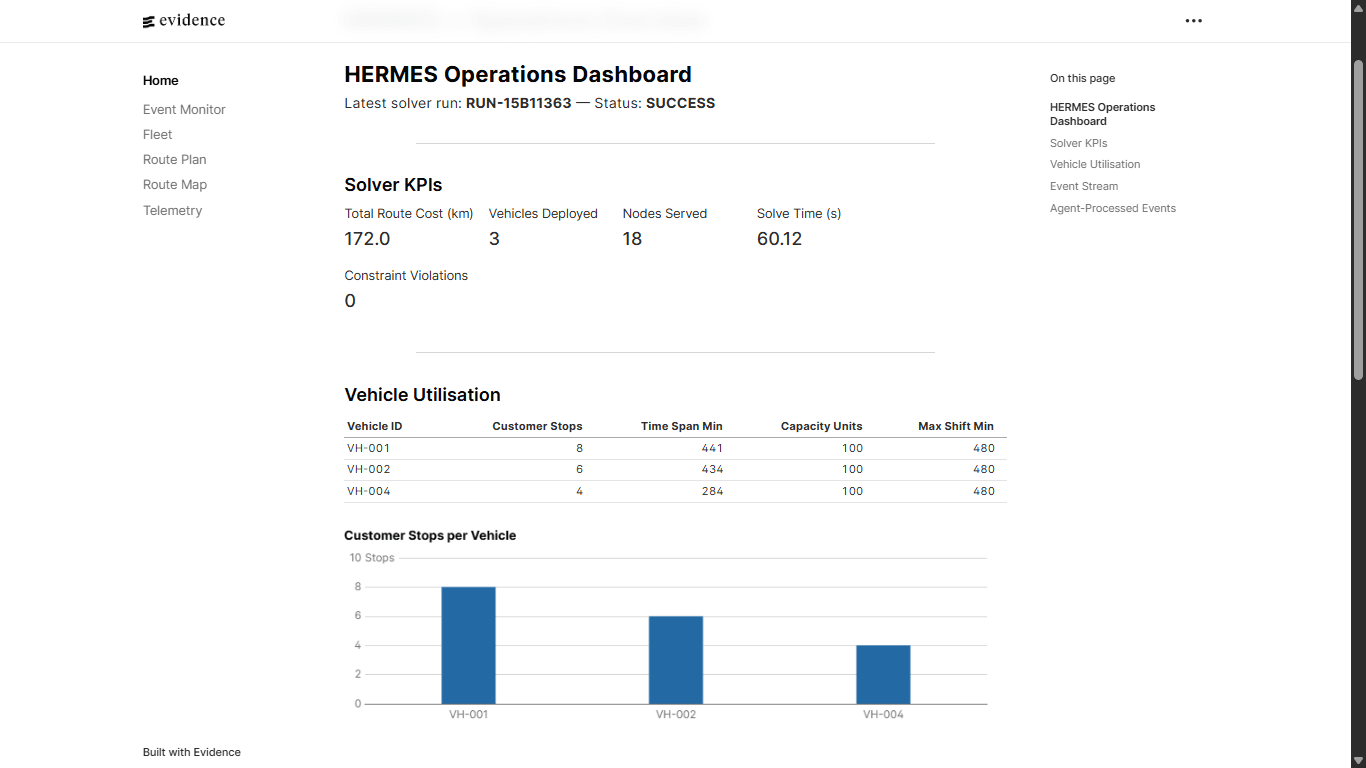
HERMES
Hierarchical Execution & Routing for Multi-agent Enterprise Supply-chain
An event-driven AI logistics platform that pairs classical Operations Research (OR-Tools CVRPTW) with a five-agent LangGraph decision layer. The architectural thesis: LLMs decide when and how to invoke the solver — they never replace it. Mathematical optimisation is authoritative; agents handle anomaly detection, SLA risk scoring, and re-solve decisions around it.
- ›Five-agent LangGraph pipeline: Monitoring → Classification → SLA Risk → Rerouting → Dispatch, with conditional edge skipping ~70% of LLM calls on nominal ticks
- ›OR-Tools CVRPTW solver with 7 hard constraints (capacity, time windows, shift limits, depot routing) — provably optimal route plans
- ›Idempotent event processing via DuckDB anti-join — agents never re-process the same event regardless of run count
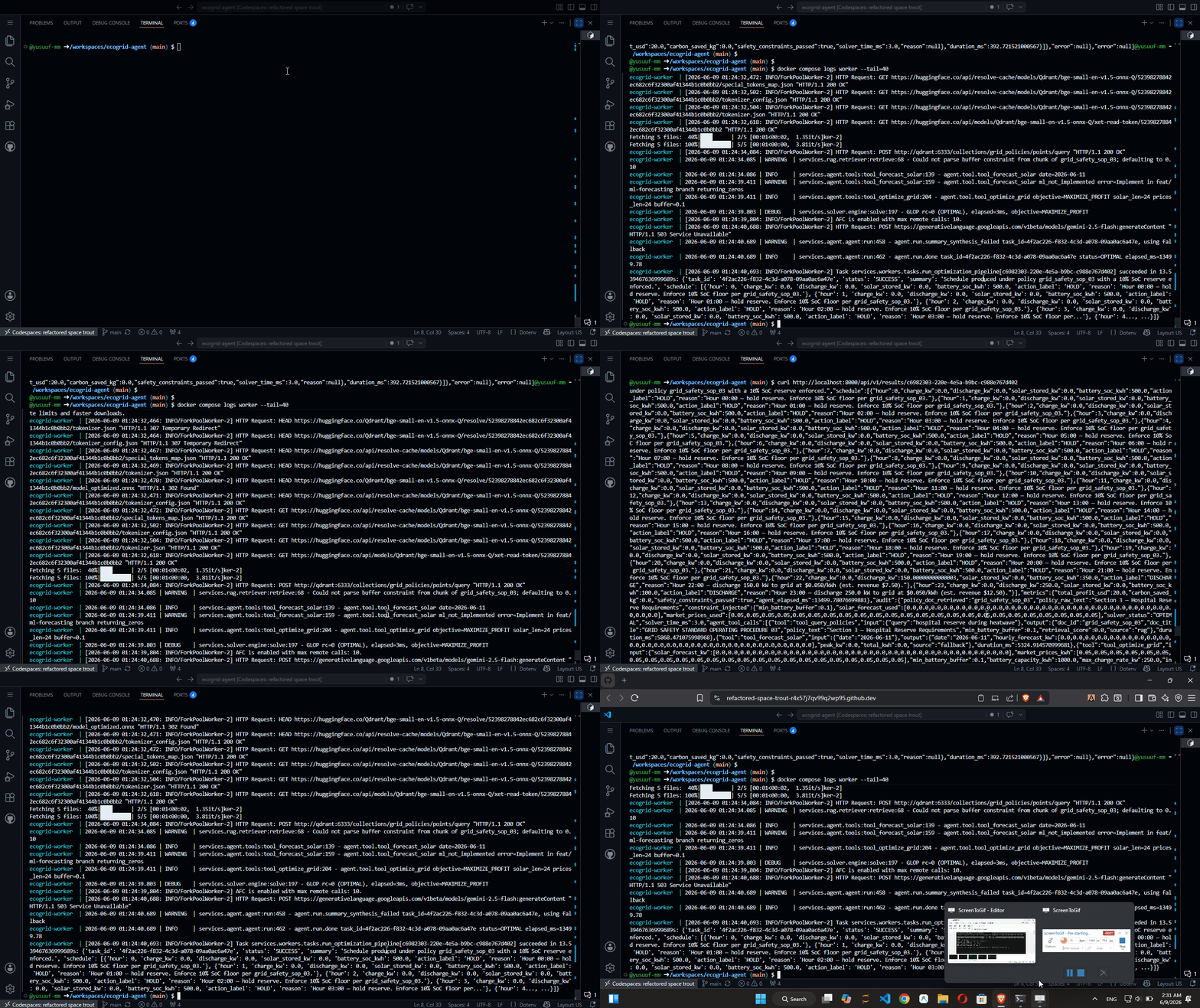
EcoGrid-Agent
Autonomous VPP Orchestrator & Grid Optimization Engine
An autonomous virtual power plant (VPP) orchestrator that parses natural language policy documents into linear program constraints, forecasts solar energy using XGBoost, and generates mathematically optimal battery charge/discharge schedules via Google OR-Tools.
- ›Deterministic three-phase pipeline: Gemini Intent Parser (using response_schema) → Qdrant Policy Retrieval → XGBoost Solar Forecast → OR-Tools LP Solver
- ›Dynamic RAG-to-constraint mapping: parses regulatory SOPs at runtime to inject safety buffers (e.g. 30% for hospital reserve) without code changes
- ›Asynchronous worker architecture: Celery + Redis offloads blocking solver computations from FastAPI to handle high-concurrency request polling
NETI–HyOptima
Net-Zero Energy Transition Intelligence
A cloud-native decision intelligence platform that turns energy transition policies into optimized strategies for hybrid energy systems: gas, renewables, storage, and hydrogen.
- ›MILP optimization engine (Pyomo) minimizing cost, emissions, and unserved energy
- ›ML forecasting: LSTM + XGBoost + Prophet for demand and renewable prediction
- ›Monte Carlo simulation for uncertainty in demand, fuel prices, weather
Real-Time Energy Data Pipeline
Cloud-Native Data Engineering
A cloud-native pipeline that handles the full lifecycle of energy distribution data: simulation, streaming, processing, storage, transformation, and optimization.
- ›Real-time IoT simulation → Kafka → Spark → PostgreSQL + S3 pipeline
- ›Stage 1 LP optimizer: fair energy allocation across 5 zones by priority
- ›Stage 2 Transportation optimizer: routes power minimizing transmission loss
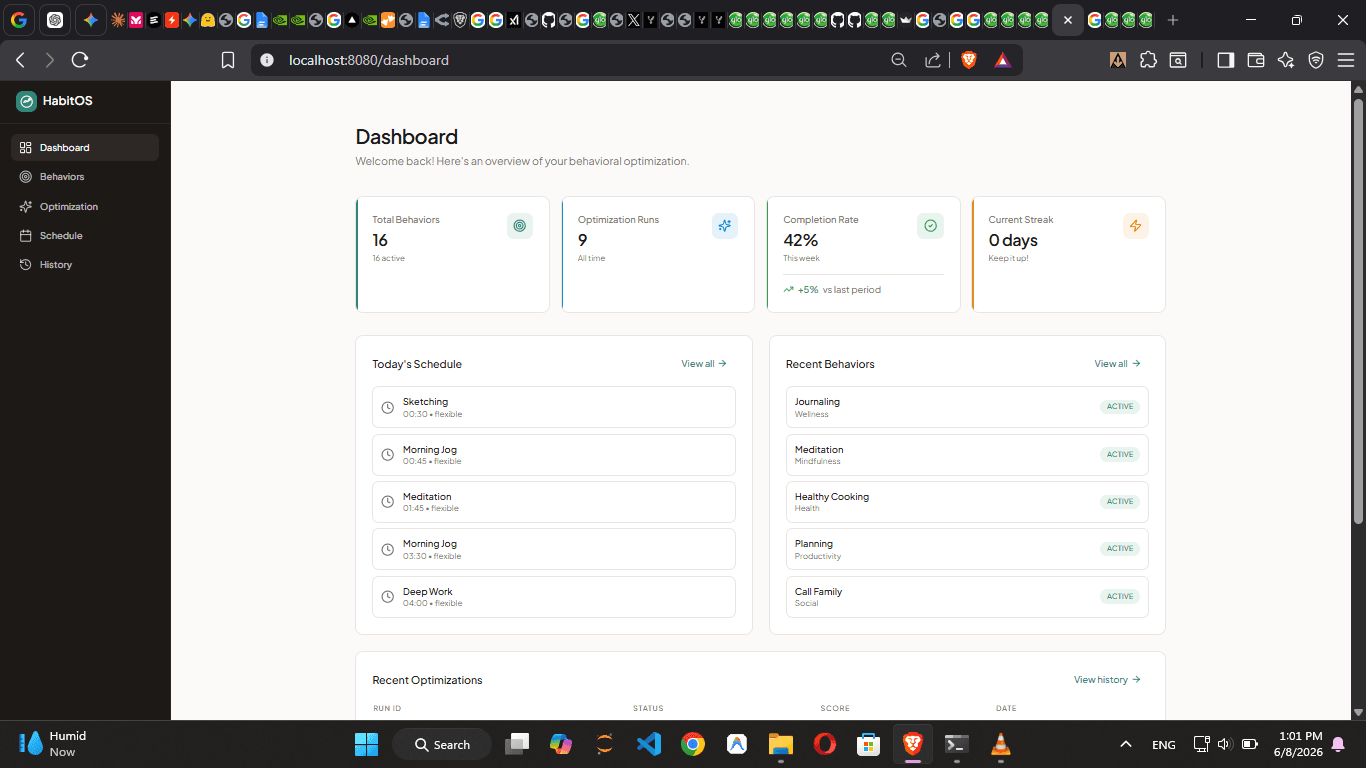
HabitOS
Behavioral Optimization Platform
A full-stack system that turns life goals into mathematically optimized daily schedules using Mixed-Integer Linear Programming.
- ›MILP solver (PuLP + CBC) optimizing daily schedule across time, energy, and behavioral constraints
- ›Solves typical schedules in under 500ms
- ›JWT authentication, role-based access, async FastAPI backend
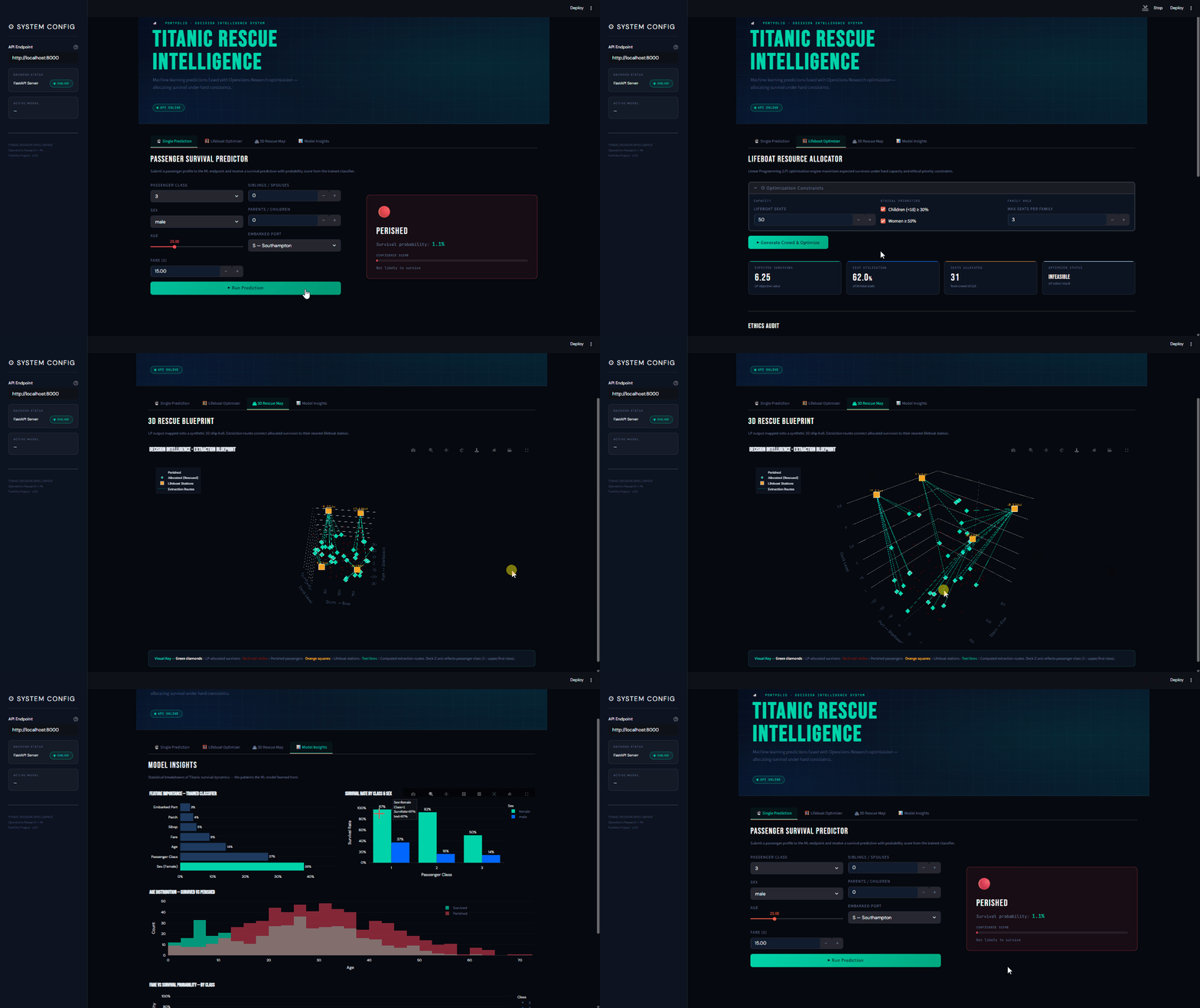
Titanic Survival & Lifeboat Optimizer
ML Prediction + Operations Research Allocation
A decision intelligence system fusing XGBoost survival prediction with Mixed-Integer Programming to solve lifeboat allocation under ethical and capacity constraints.
- ›XGBoost classifier achieving 85% accuracy and 0.82 F1 score
- ›MIP optimizer allocating lifeboat seats by survival probability + ethical constraints
- ›Ethical constraints: ≥30% children, ≥50% women priority guarantees
TOOLS I BUILD WITH
to see its project usage
Project Integration Matrix
: usage intensityLET'S BUILD SOMETHING
Open to roles, collaborations, and interesting problems.
Project Endgame
An AI agent that knows everything I've built.
Press Enter to send · Tab through suggestions